· 2 min read
AI-Assisted vs. Clinician-Derived Proximal Landmarks
New Publication
We are pleased to announce that our paper “Agreement between artificial intelligence-assisted and clinician-derived proximal femoral anatomical measurements on computed tomography” has been published in Surgical Technology International (Online First, 27 November 2026).
What We Studied
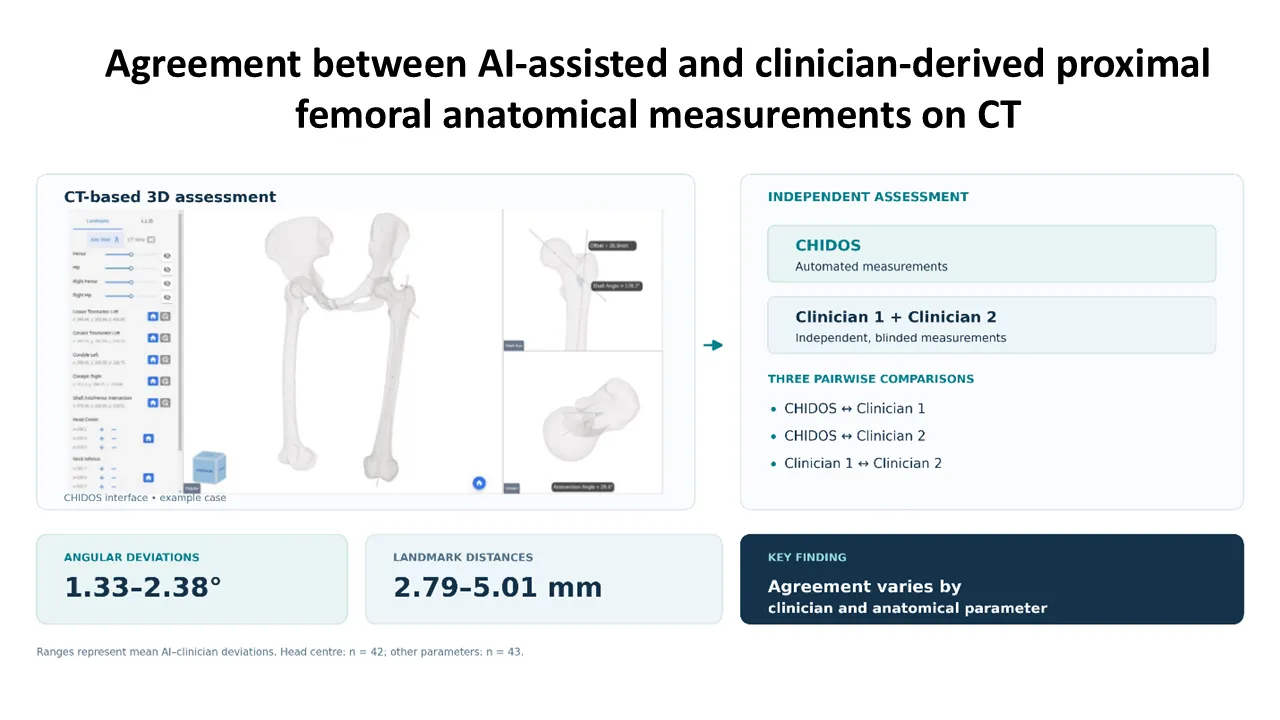
Preoperative planning for total hip arthroplasty (THA) depends on precise identification of proximal femoral anatomical landmarks — a step that remains observer-dependent. This study evaluated whether automated landmark extraction on CT falls within the range of human interobserver variability.
Forty-three CT scans from patients undergoing preoperative planning for primary THA were analyzed. Three-dimensional femoral models were reconstructed in the CHIDOS software, which automatically segmented the bone structures and extracted the anatomical landmarks. The automated measurements were compared with manual measurements independently performed by two orthopaedic consultants.
Key Findings
- Mean Euclidean deviations for landmark localization ranged from 2.79 ± 1.47 mm to 5.01 ± 1.73 mm; angular deviations ranged from 1.33 ± 0.97° to 2.38 ± 1.75°
- Agreement for angular measurements was good to excellent (ICC 0.89–0.98)
- The 95% confidence intervals of the mean deviation relative to interobserver variability lay within literature-reported margins (±3 mm linear, ±2° angular) for all five endpoints — supported by an exploratory post-hoc TOST analysis (p < 0.001 for all endpoints)
- AI–clinician deviations were lower for femoral anteversion and neck–shaft angle relative to one clinician, and for femoral neck isthmus relative to the other — a reminder that even manual measurements carry meaningful interobserver spread
Why It Matters
These findings support AI-assisted landmark extraction in CT-based THA planning workflows. As a reproducible first-pass measurement step, AI automation has the potential to reduce observer dependence and inter-clinic variability, making preoperative templating faster and more standardized — and bringing data-driven, patient-specific implant planning within reach for more patients.
Authors
Styliani Stergiadou, Antonios Koutalos, Grégoire Micicoi, Athanasios Batagiannis, Michael Klontzas, Konstantinos Malizos, Aristeidis Zibis