· 2 min read

AI-Assisted Study of Sex-Based Differences in Proximal Femoral Landmark
New Publication
We are pleased to announce that our paper “Sex-based differences in proximal femoral landmark distances relative to femoral head centre: An artificial intelligence-assisted three-dimensional computed tomography study” has been published in the Journal of Experimental Orthopaedics (JEO), 2026, 13(4), e71001.

What We Studied
Using post-mortem CT data from 195 adults (aged 45–75 years, no radiological signs of osteoarthritis and no prior hip surgery), we assessed sex-based differences in three-dimensional distances from the greater trochanter (GT), the digital fossa (DF) and the lesser trochanter (LT) to the femoral head centre (FHC) — and whether those differences persist after normalizing to femoral length.
All landmarks were detected and all parameters extracted by our custom artificial intelligence planning software, in the same spirit as the AI landmark-detection work we presented at the ESSKA Congress earlier this year.
Key Findings
- The GT–FHC, DF–FHC, LT–FHC and LT–GT distances remained significantly greater in males even after adjustment for femoral length (adjusted differences of 2.89–3.85 mm, all FDR-adjusted p < 0.001)
- Femoral anteversion was greater in females (16.03° vs. 10.60°, p < 0.001), while femoral offset was greater in males (34.95 vs. 32.20 mm, p = 0.004)
- Anteversion decreased and offset increased with femoral length — both without significant adjusted sex differences; the neck–shaft angle showed no such association
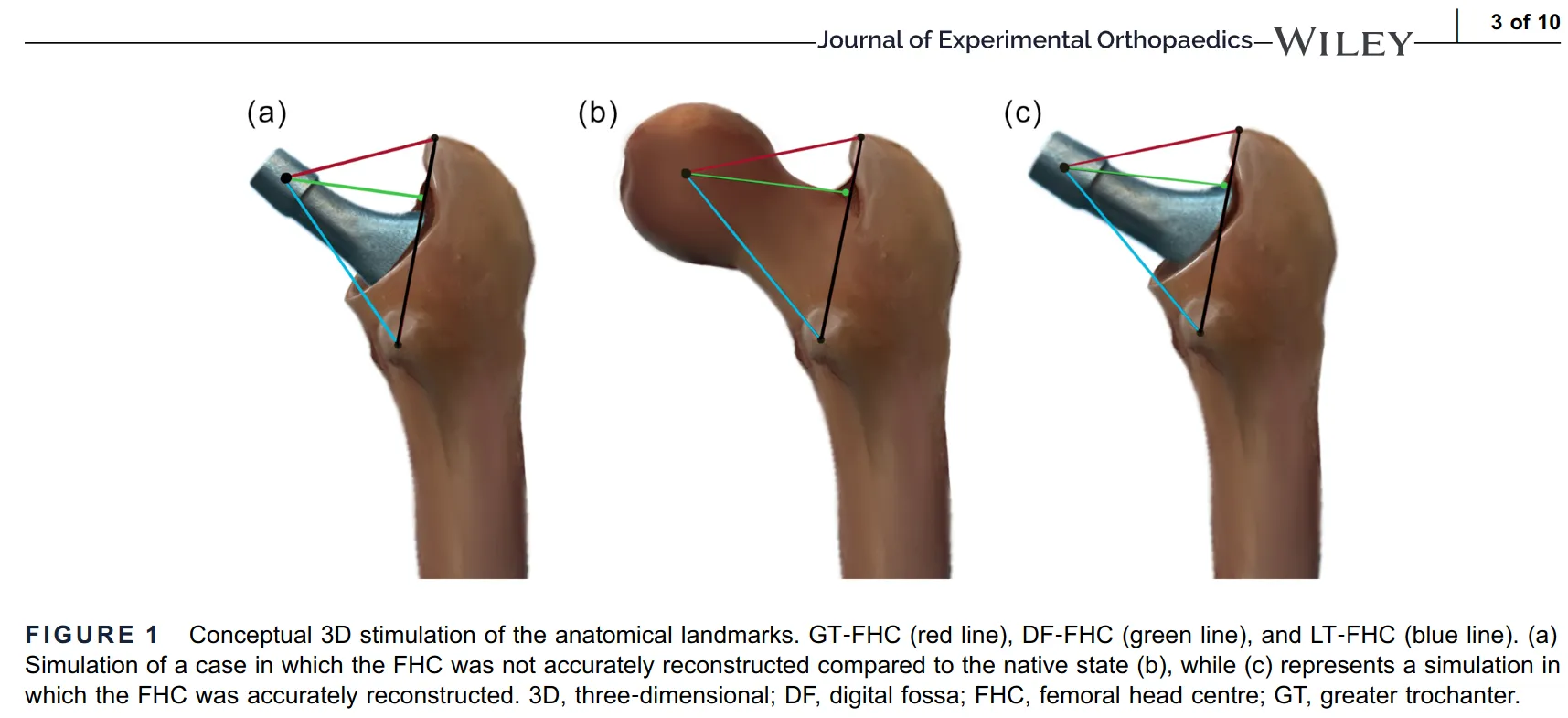
Figure 1. Conceptual 3D simulation of the anatomical landmarks: GT–FHC (red line), DF–FHC (green line), LT–FHC (blue line). (a) Case in which the FHC was not accurately reconstructed compared to the native state (b); (c) represents a simulation in which the FHC was accurately reconstructed.
Why It Matters
Accurate restoration of the femoral head centre is a cornerstone of total hip arthroplasty. Our results show that proximal femoral landmark distances are influenced by both sex and femoral length — a reminder that one-size-fits-all landmark targets in implant templating may not be ideal, and that personalized, data-driven surgical planning has real anatomical grounding.
The clinical reliability of these landmarks, and their implementation in templating for total hip arthroplasty and accurate FHC restoration, will be the subject of further investigation.
Authors
Styliani X. Stergiadou, Cathal McCarthy, Grégoire Micicoi, Panagiotis Kontopoulos, Athanasios Batagiannis, Michael Hantes, Konstantinos N. Malizos, Aristeidis Zibis, George M. Avram